


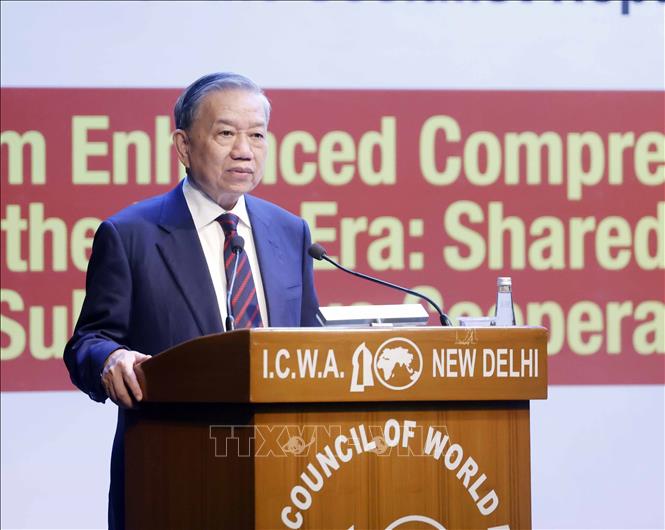
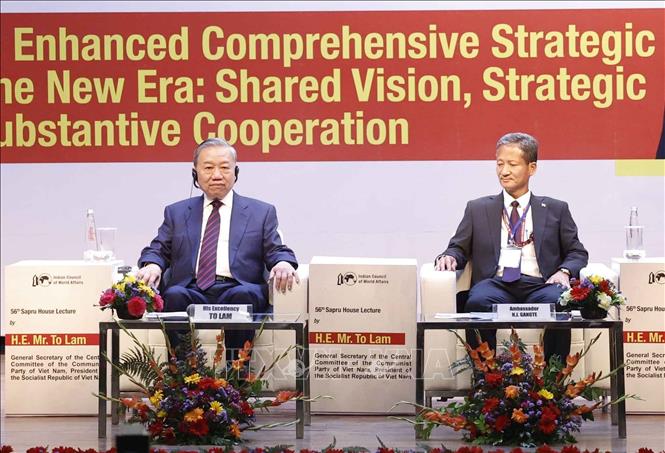
As part of his State Visit to the Republic of India, on the afternoon of May 6 (local time), General Secretary of the Communist Party of Viet Nam Central Committee, President of the Socialist Republic of Viet Nam To Lam delivered a policy address at the Indian Council of World Affairs under the theme: “The Enhanced Viet Nam–India Comprehensive Strategic Partnership in a New Era: Shared Vision, Strategic Convergence, and Substantive Cooperation.”
Honorable Shri Chandrapuram Ponnusami, President of the Indian Council of World Affairs,
Distinguished guests,
Dear friends,
Namaste!
It is a great pleasure to visit the Indian Council of World Affairs, and meet you, the leading international relations scholars and experts of your country. The Council is a premier strategic research organ and one of the most prestigious in the world with its history of eighty years and role as the frontrunner and shaper of Indian foreign relations. This historic Sapru House is a witness to a great many watershed moments in the history of India, of Asian states, of the world and of Viet Nam also, a gathering place for leaders, politicians and diplomats all over the world.
Here, in 1947, a watershed conference took place: the First Asian Relations Conference, that germinated the birth of the Non-Aligned Movement that linked together India, Viet Nam, and other states that shared an aspiration for independence, peace, cooperation, and development in fairness and prosperity. The message of peace and solidarity that President Ho Chi Minh conveyed to the conference was: “Through solidarity, we shall be one of the strongest guardians of global peace and democracy” to great applause in India and the world. This was one of the first links between the two newly-independent countries of India and Viet Nam, and marked one of the first multilateral diplomacy events that the independent Viet Nam attended.
For our discussion today, I would like to speak to you about the relationship between Viet Nam and India in a new era: an Enhanced Comprehensive Strategic Partnership of shared vision, convergence of strategic interests, and substantive collaboration.
Ladies and gentlemen, dear friends,
- If we look back upon thousands of years of our two countries in the making, history and culture have been the ties that bind Viet Nam and India together.
Our two countries are not adjacent. Yet the ties between Viet Nam and India had emerged early. Through maritime trade routes, the flower of Indian faiths, religions, philosophies and civilization spread early and become part of the cultural and spiritual life of the Vietnamese people. These links are evident in hundreds of monuments all over Viet Nam: the Luy Lau Buddhist center, the My Son sanctuary, the Cham towers, the Ponagar tower, relics of Hinduism, Buddhism, hand in hand with the Vietnamese people’s philosophy of benevolence. These links today live on, expressed in new, diverse ways. Your national leaders have paid, for example, many visits to Viet Nam to attend the International Day of Vesak, among which I should name Vice President Venkaiah Naidu’s 2019 visit.
Generations of Vietnamese have found familiarity in the Ramayana, the Indian heroic epic that give praise to bravery, loyalty and sacrifice, and shape what these virtues mean. From its origin in India, Yoga has grown in popularity in Viet Nam, with four thousand clubs all over the country and 500,000 regular practitioners. Every year tens of thousands of Vietnamese Buddhists and visitors go on a pilgrimage to the Bodh Gaya in Bihar.
The journey of struggle for national independence and construction has brought about deep empathy, unity and solidarity between our two countries’ peoples and leaders from one generation to the next, beginning with the respect President Ho Chi Minh had for your great leader Mahatma Gandhi, and his close friendship with your first Prime Minister Jawaharlal Nehru, as they strove for independence, peace, equality and prosperity together. We shall never forget that Prime Minister Jawaharlal Nehru was the first foreign Head of Government to pay a visit to Viet Nam in 1954, a mere week after the liberation of Hanoi. This was a demonstration of the immense support that your People and Government accorded to the cause of the Vietnamese people. Nor shall we ever forget “Mera Nam, Tera Nam, Việt Nam – Việt Nam”, that resounded along the streets in so many Indian cities, that evidenced the solidarity and camaraderie between our two Peoples in the struggle for peace, independence and freedom for our nation. Nor, of course, shall we forget our Indian friends who stood firmly on our side in the years of hardship after national reunification.
Viet Nam treasures and memorializes that support, immense and profound and invaluable, that the People, parties and Government of India had given to Viet Nam throughout the years of struggle in defense of national independence and freedom in the past, just as the concrete support and assistance pledged to Viet Nam in our national reconstruction and development of today.
Ladies and gentlemen, dear friends,
- Indeed, the developmental journeys of our two countries over the past eighty years share many commonalities, and have yielded monumental gains.
Both our countries, first of all, started out as colonial economies in great distress, exploited to the bone one may say: underskilled, unbalanced, reliant on foreign countries. Yet with our dream of prosperity, of bringing wellbeing and happiness to our people, both countries have gradually built for ourselves independent, self-reliant, solid economies.
India today has become the fastest growing major economy in the world, forging ahead at 7.6% last year against global headwinds, maintaining the record growth of six percent on average over three consecutive decades, making itself one of the most important engines for global growth. Now the Indian economy stands at fourth place in the world and is well on the way to third place. It has become a technological powerhouse, one of the most dynamic digital, innovative and AI economies in the world, with the Bengaluru center, the Hyderabad biotech center, and high-quality HR training centers such as the globally influential Indian Institute of Technology (IIT). The Indian Space Research Organization (ISRO)’s space program has brought India into the shortlist of global space capability leaders.
Viet Nam, after forty years of Doi Moi and intensive regional and international integration, now has a 514-billion economy, a hundredfold where it was before Doi Moi, ranking 32nd in the world and fourth in ASEAN. It occupies the 44th place out of 139 countries in the global innovation index, and boasts a startup ecosystem ranking 55th in the world. Poverty rate has fallen sharply, from 70% in the mid-1980s to 2.95% in 2025 according to the multilateral poverty standard, lifting millions out of poverty in the process.
In foreign relations, both countries share a common view on independence, self-reliance, self-empowerment and peace, a strong support for dialogue, and an active, balanced and responsible approach towards regional and global issues. I am deeply taken with the Indian philosophy of Vasudhaiva Kutumbakam: the whole world is a family. It upholds friendship, respect, solidarity and a desire for peace and prosperity, the very values that the Vietnamese nation consistently aim for. We very much appreciate your responsible contributions through strategic cooperation frameworks and connectivity initiatives. The Act East Policy to forge a closer bond with Southeast Asia; the Indo-Pacific Initiative to advance an open, inclusive, rules-based space. We also applaud India’s growing prominence at multilateral mechanisms, especially the UN, G20, BRICS, the Indian Ocean Rim Association, and the Bengal Initiative for Multi-Sectoral Technical and Economic Cooperation, all of which had contributed to dialogue, connectivity, and the solution of common challenges.
Viet Nam, on our part, has also successfully assumed important international responsibilities, such as ASEAN Chairmanship, APEC host, non-permanent member of the UNSC, member of the UNHRC, Vice-President of the UN International Law Commission, member of the Board of Governors of the International Atomic Energy Agency (IAEA), and member of various governance organs under the (UNESCO). Viet Nam has also sent officers and servicemen to UN peacekeeping missions.
Both Viet Nam and India are marching towards new developmental goals to celebrate a hundred years of independence, to keep a balance between growth and social progress, in which process the role of science and technology are indispensable. India has set its sights on the 2047 Viksit Bharat, to make India a developed country, striking a balance between economic growth, social progress, environmental sustainability, governance efficiency, and scientific and technological capability.
Viet Nam has also set a dual goal: by 2030, to become a developing country with modern industries, upper-middle income, and by 2045, to become a developed, high-income country. This double centenary target are immensely strategically significant, an expression of the Vietnamese nation’s desire for growth in a new era.
To do so, we must strongly innovate our growth model, foster rapid and sustainable development, maintain independence and self-reliance, hand-in-hand with intensive and effective international integration. Most importantly, we view the development of science, technology, innovation and digital transformation as not only a tool to support development, but also the main driver of development itself.
The relationship between our two countries, therefore, are shaped and cultivated on the ground of trust and camaraderie. Diplomatic relations began in 1972, the upgrade to Strategic Partnership took place in 2007, followed by the Comprehsnsive Strategic Partnership in 2016, and has only grown broader and deeper ever since. Bilateral traded tripled after a mere decade, to a record figure of 16.5 billion in 2025. India currently employs 400 investment projects in Viet Nam worth more than 1 billion. Viet Nam’s Vinfast is investing into EV production in India, having pledged $2 billion over the first five years.
Defense and security cooperation continue to be a strategic pillar with a wide range of credit support and tech transfer programs. Education, training, tourism and people-to-people ties have also been expanded. More than 80 direct flights between our two countries take off and land every week.
Ladies and gentlemen, dear friends,
- Relations between Viet Nam and India is stepping up on a new stage.
The world is changing swiftly and deeply like never before. Competition among major centers of power are expanding. International law, the UN and multilateral institutions are facing unprecedented challenges.
All countries, including both Viet Nam and India, are facing the paradoxes of our time: the need for cooperation grows greater, yet trust is wearing thin. Economic structures are more deeply interconnected, yet are more vulnerable. Technologies are leaping ahead, yet are deepening the development gap between nations. Changes are creating immense challenges, but above all they also open up opportunities for the taking if we can grasp them at the right time, and opportunities shall multiply if we are linked together.
Ladies and gentlemen, dear friends,
- The new backdrop and demands of our two countries’ new developmental stage call for us to strengthen, innovate, and elevate the relationship between Viet Nam and India to a greater height
Our respective developmental journey, and that of our relationship, has shown that Viet Nam and India have become each other’s natural partners concerning peace, security and development. We share a common view and vision as to the making of our nation, our region, our world, and international relations, which is to say: (i) Strategic self-reliance and balance, (ii) the respect for international law and support for the UN and the multilateral system, (iii) The defense and making of peace, and diversification of partners, (iv) The championing of dialogue in search of commonalities to narrow down differences; and (v) The support for a fair and inclusive regional and international order.
Many of our strategic interests also converge, especially to: (i) Advance peace and stability to pave the way for development and prosperity; (ii) Building intertwining interests across various theaters: economic, trade, defense, security, science and technology, to elevate the connectivity and resilience of our bilateral tie; (iii) Champion freedom and security of navigation and overflight, the peaceful settlement of disputes through peaceful means, to foster an open, inclusive and stable Indo-Asia-Pacific; (iv) Augment cooperation at regional multilateral mechanisms.
These links, shared visions, and strategic convergence provide a solid foundation for Viet Nam and India to step up cooperation and make effective contributions to the developmental journey of each country in a new eara, while contributing to the shaping of a more stable and enduring regional and international environment.
As a continuation of the solid foundation our relationship has had over the past fifty years, and to bring this bond of cooperation into a new era, a new height – the enhanced Comprehensive Strategic Partnership, with sharing vision, converging strategic interests, and forging concrete cooperation as our watchwords, to unleash potentials, explore new areas, and open new fields. As such, we should work on the following key lines of action:
(i) First, we must reinforce and deepen strategic trust as the premise for a stable relationship and the foundation for effective cooperation and response to common challenges. Over the past fifty years, Viet Nam – India relations has been a special bond, clear as the cloudless sky, to quote the late Prime Minister Pham Van Dong. It is special and pure, because it was founded upon historic, cultural ties, mutual understanding and empathy and respect, policy consistency, built in common cause between generations our two countries’ leaders and peoples. It is special and pure, because there is no conflict between our interests, and a great deal of stability in our cooperation.
In the new era, we must: (1) Continue to foster comprehensive exchanges across all channels: State, Parliamentary, Party, People, and at all levels, both central and local; (2) Expand cooperation in strategic sectors. Excellent as defense and security cooperation has been, it should grow better and deeper; and available as cooperation mechanisms are, they must be better harnessed. We should enhance collaborative action and coordination of our respective positions at multilateral forums, including the ASEAN, the UN, the Non-aligned Movement, especially as the regional and international landscape is evolving in such complex ways.
(ii) Second, we should broaden room for connectivity and intensify developmental linkages to lend more impetus to regional connectivity. The development of infrastructure, logistics, digitalization and value chain linkages is an important part of bilateral connectivity. For highly complementary sectors, such as pharmaceuticals, IT, high-tech agriculture and clean energy, we should advance concrete cooperation projects, including joint production, technology transfer, market development, to jointly engage more deeply with regional supply chains.
We stand ready to work together with India in the pharmaceutical sector. We welcome Indian pharmaceutical firms investing into manufacturing in Viet Nam for the Southeast Asian market. We should also expand mechanisms to forge direct links between our businesses and our localities through cooperation forums and investment promotion programs. This way we will turn cooperation guidelines into concrete projects tailored to each sector, locality and supply chain.
Relations between Viet Nam and India is a strategic column linking Southeast and South Asia. Through the enhanced Comprehensive Strategic Partnership, the ASEAN-India framework, Mekong-Ganga cooperation, among others regional cooperation initiatives, our two countries may well help reinforce an open, inclusive and dynamic developmental space.
At the same time, new ways of thinking, new missions, new areas of cooperation must go together with a new way of doing: decisive, and whose effectiveness measurable by pace and concrete outcomes.
(iii) Third, we need to elevate and accelerate scientific, innovation, and strategic technology cooperation, and make this field into a keystone of Viet Nam – India cooperation. Knowledge, technology and innovation has become a key driver of growth and a new factor determining a nation’s combined power and competitiveness. This calls for deeper, more diverse manners of cooperation in areas that would shape our future, such as digital economy, data, semiconductor and AI.
We attach special importance to cooperation with India in the field of science and technology, especially in strategic sectors such as semiconductor, AI and digital transformation. I believe we are very well positioned to more vigorously pursue and explore complementary areas of cooperation, drive strategic cooperation in science and innovation and strategic technology, not only through setting guidelines but also in implementation. This can be done through identifying spearheads and their delivery model; establishing collaboration programs between research centers, universities and businesses; and fostering education and movement of quality talents between our two countries.
(iv) Fourth, we should disseminate socio-cultural values and strengthen people-to-people ties. The longevity of relationships among nations are forged not only through cooperation frameworks, but also through links between human beings, between societies. Last year saw one million travelers between our two countries, showing how deep and broad the connections we share have grown. This is a giant step forward compared to five or six years ago, yet remains very small compared to the size of our populations and our economies.
We should continue to broaden and deepen these links through educational and training, culture, tourism, locality cooperation, and people-to-people links. It is from lecture halls, labs, research projects and young startups that mutual understanding and trust shall naturally grow and take root.
This understanding and empathy, accumulated over centuries, is an invaluable asset to be treasured and preserved, and a source of inspiration urging both countries to work together disseminate and augment noble values for the region and the world. Such values, once inherited and advanced by the young generation, shall play a role in reinforcing the very foundation of bilateral relations towards the future.
(v) Fifth, we must together build and reinforce a space for peace and stability, We are all well aware of the value of peace. In the world today, it is all the plainer to see that peace does not merely mean the absence of war and conflict. It means also the building and reinforcing of structural, institutional and cultural conditions to promote sustainable peace and justice and prosperity for all mankind. Peace, too, is not to be taken for granted. It is the outcome of sincere dialogue, of responsibility in the conduct of affairs among states, of unwavering respect for the fundamental principles of the UN Charter and international law. Our two countries’ advancement of dialogue, championing of the rule of law and peaceful settlement of disputes, and positioning of development as the interest of our people are not just protecting our respective legitimate interests, but are also a direct contribution to the maintenance of an open, transparent, inclusive and rules-based regional order.
Ladies and gentlemen,
- Conclusion:
The thousands of years of our links and more than fifty years of diplomatic relations have provided a solid and invaluable foundation for the relationship between Viet Nam and India. We are connected by threads woven by the depth and breath of history and commonalities along our developmental paths. India has always been, to Viet Nam, an instrumental partner and a close, trusted friend.
We are entering a new era, equipped with the Enhanced Comprehensive Strategic Partnership elevated to a greater height, and shared vision, strategic convergence and substantive cooperation as our motto. Given active government solution, and the spirit of determination, solidarity, innovation and creativity of our respective business communities, certainly relations between Viet Nam and India would grow stronger, more substantive and our links further bolstered, to bring about tangible benefits and success to the development of each country, and contribute positively to peace, stability, cooperation and prosperity in the region and the world.
May good health and success be with you.
May the friendship between our two nations grow closer and greater
Thank you very much.

Related Post